How Can UGC Ads Build Stronger Trust and Engagement for Modern Brands?

What makes people stop scrolling and actually believe an advertisement? UGC advertising can help answer that question by bringing a more personal, experience-driven style to digital campaigns. Instead of relying entirely on polished brand photography or traditional promotional messages, this approach presents products through demonstrations, testimonials, reviews, reactions, and everyday experiences that feel closer to the content audiences already consume.
For brands, the main advantage is simple: relatable creativity can make a product easier to understand and a message easier to trust. When viewers can see how an item fits into a realistic situation, they may connect with the advertisement more naturally.
What Are UGC Ads and Why Do They Matter?
UGC Ads refers to promotional content designed around the appearance and storytelling style of content created by customers or individual creators. It can include product reviews, tutorials, unboxing videos, testimonials, before-and-after demonstrations, lifestyle clips, and short-form recommendations.
The format can be particularly useful on social platforms because it matches the fast, informal viewing experience users are accustomed to.
Effective campaigns often focus on three elements:
Relatability: The situation feels familiar to the target audience.
Demonstration: The product is shown solving a real problem or fulfilling a need.
Personality: The speaker or creator communicates naturally rather than sounding like a traditional advertisement.
The objective is not to make every advertisement look amateurish. Instead, brands can combine professional production standards with authentic storytelling.
How Can User-Generated-Style Advertising Increase Trust?
Consumers increasingly encounter promotional messages throughout their online experience. When every advertisement looks highly polished, audiences may immediately recognize the commercial intent.
Creator-led storytelling can introduce a different experience. A person explaining how they use a product, showing its features, or describing a personal experience can make the information feel more accessible.
Trust can be strengthened when the content:
Demonstrates the product clearly.
Addresses a genuine customer concern.
Uses straightforward language.
Shows realistic product usage.
Avoids exaggerated promises.
Provides enough context for viewers to make informed decisions.
Authenticity should not mean making unsupported claims appear credible. Brands still need to review statements, disclose appropriate partnerships, and ensure that promotional content is accurate.
Which Formats Work Well for UGC Campaigns?

There is no universal format that works for every product. The strongest choice depends on the audience, platform, buying journey, and complexity of the offer.
Common formats include:
Product Demonstrations
A creator shows how a product works and explains its practical benefits. This works particularly well when the product requires visual explanation.
Personal Testimonials
A customer or creator describes a problem and explains how the product helped address it. The strongest versions focus on specific experiences rather than generic praise.
Tutorials and How-To Videos
These provide immediate educational value while naturally introducing the product.
Unboxing Content
Unboxing can showcase packaging, product design, accessories, and the first-use experience in a visually engaging sequence.
Comparison Content
A creator can explain differences between options, helping audiences understand why a particular product may suit their needs.
How Can AI UGC Ads Help Brands Scale Creative Production?
Producing numerous creator-style advertisements traditionally requires considerable planning, filming, editing, and coordination. Artificial intelligence can help accelerate parts of this process by supporting concept development, scripts, variations, editing workflows, personalization, and creative experimentation.
AI UGC ads can be particularly useful when marketers want to explore multiple storytelling directions before investing heavily in production. For example, a campaign might test different hooks focused on convenience, affordability, product performance, customer experience, or a specific use case.
AI can also help teams adapt one successful concept into several variations. A single campaign idea could be transformed into different opening lines, lengths, formats, captions, and calls to action.
However, automation should support authenticity rather than imitate real customer experiences deceptively. Brands should maintain transparency and ensure that generated or simulated creator content does not mislead audiences.
How Should Brands Structure a Strong UGC Campaign?
A successful campaign begins before the camera starts recording. Marketers should first determine what the advertisement needs to accomplish.
A practical process is:
Step 1: Define the audience.
Identify the people most likely to benefit from the product.
Step 2: Identify the customer problem.
Understand what frustration, need, aspiration, or question the advertisement should address.
Step 3: Develop several hooks.
Create opening statements that immediately establish relevance.
Step 4: Demonstrate the value.
Move quickly from the problem to the product experience or solution.
Step 5: Add proof.
Use demonstrations, specific experiences, product details, or appropriate social proof.
Step 6: Finish with a clear action.
Tell viewers what they can do next without making the CTA unnecessarily complicated.
This structure keeps creator-style advertising focused while leaving enough room for personality.
How Can Marketers Measure Campaign Performance?
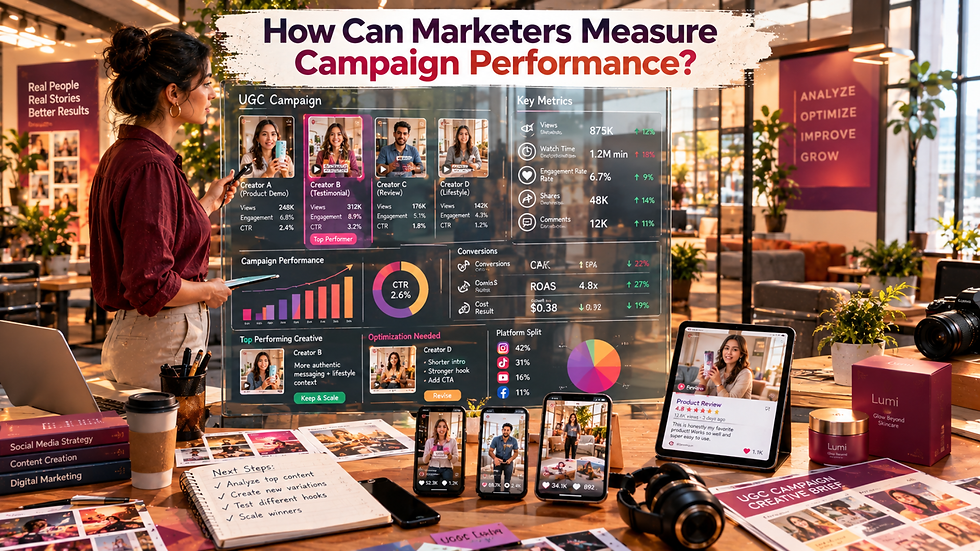
Creative quality should ultimately be connected to measurable business outcomes. Marketers should evaluate performance based on the objective of the campaign rather than focusing on a single vanity metric.
Important indicators may include:
Video views and completion rate
Engagement rate
Click-through rate
Landing-page visits
Conversion rate
Cost per acquisition
Return on advertising spend
Add-to-cart activity
New customer acquisition
It is also useful to compare different creative approaches. If one hook generates many views but few conversions, while another attracts fewer viewers but produces more purchases, the second concept may have greater commercial value.
What Mistakes Should Brands Avoid?
Creator-style advertising can lose effectiveness when brands treat it as a simple production shortcut.
Common mistakes include:
Making every video follow the same formula
Using creators who do not match the audience
Focusing only on appearance instead of substance
Making unsupported product claims
Hiding important sponsorship information
Using excessive editing that removes natural personality
Repeating the same creative for too long
Ignoring performance data
The strongest campaigns continuously refresh their concepts while maintaining consistent brand positioning.
How Can Brands Make UGC Style Content Feel Authentic?
The phrase UGC style content describes advertising that adopts characteristics commonly associated with creator or customer-generated media. Its effectiveness depends heavily on whether the presentation feels natural to the intended audience.
Brands can improve authenticity by allowing creators to use their own communication style instead of forcing every person to follow an identical script.
Useful practices include:
Encourage natural speech.
Keep appropriate imperfections rather than over-editing every frame.
Use realistic environments.
Focus on genuine product experiences.
Avoid excessive promotional language.
Match the creator to the intended audience.
Keep the opening focused on a recognizable customer problem.
Authenticity is also influenced by context. A fitness product may work better in a gym or home workout environment, while a kitchen product could be demonstrated during an actual cooking routine.
How Can UGC Advertising Become Part of a Long-Term Strategy?

Rather than treating creator-style advertising as a temporary trend, brands can build a repeatable creative system around it.
A strong long-term approach combines audience research, creator selection, structured experimentation, performance analysis, and ongoing creative refreshes.
Teams can maintain a library of successful hooks, product demonstrations, objections, testimonials, and storytelling approaches. This creates a foundation for future campaigns without forcing marketers to start from scratch every time.
The most important principle is to preserve the connection between real audience needs and useful advertising messages. Technology can accelerate production, but relevance remains the foundation of effective creativity.
You can also watch: Create Professional AI UGC Ads & B-Rolls in Seconds with AdsGPT
Summary
UGC Ads can help brands make digital advertising more relatable by combining product information with creator-style storytelling, demonstrations, testimonials, and real-world experiences. Their value comes from making promotional messages easier to understand and more naturally connected to the audience's everyday content environment.
AI can further support creative production by helping marketers develop variations and test different approaches. However, authenticity, transparency, accurate claims, audience relevance, and human judgment should remain central to the strategy.
FAQs
What are UGC Ads?
They are advertisements that use customer- or creator-style storytelling to present products through experiences such as reviews, demonstrations, testimonials, tutorials, and lifestyle content.
Are UGC campaigns only suitable for social media?
No. Creator-style assets can also be adapted for landing pages, websites, email campaigns, display advertising, product pages, and other digital marketing channels.
Can AI create UGC-style advertisements?
AI can assist with scripts, concepts, variations, editing, and simulated creator-style assets, but brands should use these capabilities transparently and avoid presenting fictional experiences as genuine customer testimonials.
What makes UGC advertising effective?
Relevance, credible storytelling, clear product demonstrations, strong hooks, audience fit, and a natural communication style can all contribute to stronger performance.
How often should brands refresh UGC creative?
There is no universal schedule. Brands should monitor performance and audience response, then refresh creative when engagement or conversion performance begins to decline or when new audience insights emerge.


Comments