How Can Meta Ads Creative Make Social Advertising More Engaging?

What makes a social advertisement stand out when audiences scroll past hundreds of posts every day? The answer often comes down to the quality and relevance of the creative. Strong visuals, concise messaging, clear calls to action, and audience-focused storytelling can help businesses capture attention and encourage meaningful interactions.
A successful advertising creative does more than look attractive. It should communicate a useful message quickly, match the audience's expectations, support the campaign objective, and provide a clear reason to take action. For brands competing in crowded social feeds, this combination can make creative strategy a significant contributor to campaign performance.
What Makes a Strong Social Advertising Creative?
A meta ads creative should connect the brand's message with what the target audience actually wants to see. Rather than designing an advertisement around appearance alone, marketers should consider the customer's problem, motivation, awareness level, and likely next action.
Several elements can influence creative effectiveness:
Visual relevance: Images or videos should immediately relate to the product, service, or message.
Clear messaging: Audiences should understand the main benefit without reading lengthy copy.
Strong hierarchy: Important information should be visually prioritized.
Recognizable branding: Logos, colors, typography, and brand style should remain consistent.
Action-oriented messaging: The call to action should clearly communicate what users can do next.
Mobile-first design: Creative should remain readable and compelling on smaller screens.
The strongest advertisements generally make the value proposition obvious within seconds.
How Can Brands Create More Relevant Ad Concepts?

Creative development becomes easier when marketers begin with audience insight instead of jumping directly into design.
Start by identifying:
Who is the audience?
What problem are they trying to solve?
What benefit matters most to them?
What objection could prevent action?
What type of message would feel relevant to their current stage?
For example, a person discovering a product may respond to educational content, while someone who has already visited a product page may need a reminder, testimonial, comparison, or compelling offer.
This audience-first approach can produce creative concepts that feel more personalized without requiring every advertisement to be completely different.
Can AI Generated Content Speed Up Creative Production?
Modern marketing teams often need a large volume of content across different formats and placements. Meta Ad can help accelerate brainstorming, copy development, headline variations, social captions, product descriptions, and initial creative concepts.
The technology can be especially useful during the early stages of production. Instead of starting from a blank page, marketers can provide a campaign brief and use AI-assisted suggestions as starting points.
However, generated material should not automatically be published. Human review remains important for:
Brand voice
Factual accuracy
Originality
Customer relevance
Legal and compliance requirements
Product claims
Visual consistency
AI can increase production speed, but strategic direction and editorial judgment still determine whether the final advertisement is genuinely useful.
How Can Different Creative Formats Improve Engagement?
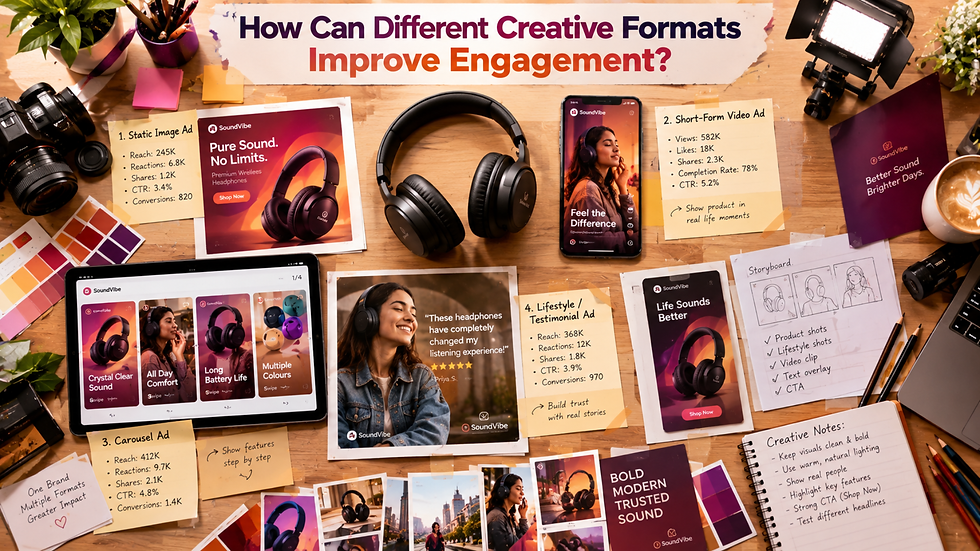
Different audiences respond to different forms of communication. Businesses should therefore avoid assuming that one format will work equally well across every campaign.
Useful creative formats can include:
Short-Form Video
Brief videos can demonstrate products, explain benefits, show customer experiences, or communicate a story quickly.
Static Images
Well-designed static advertisements can deliver a focused message without requiring users to watch a video.
Carousel Creative
Multiple cards can help businesses showcase product features, explain a process, compare options, or present several products.
Testimonial-Based Creative
Customer experiences can provide social proof and help address uncertainty before a purchase decision.
Product Demonstrations
Showing how something works can communicate value more effectively than describing every feature through text.
The right format should be selected according to the campaign objective and audience behavior rather than popularity alone.
Which Metrics Should Businesses Monitor?
Creative performance should be evaluated against the campaign's actual objective.
Important indicators may include:
Click-through rate: Helps measure how effectively creative encourages clicks.
Engagement rate: Shows how audiences interact with the advertisement.
Conversion rate: Indicates how effectively traffic turns into desired actions.
Cost per acquisition: Helps assess acquisition efficiency.
ROAS: Connects advertising investment with attributed revenue.
Video completion rate: Useful for understanding video consumption.
Landing-page behavior: Helps reveal whether the creative attracts relevant visitors.
A high click-through rate is not automatically a success if those clicks fail to produce meaningful business outcomes.
Why Should Marketers Test Multiple Creative Ideas?
Even experienced marketers cannot always predict which advertisement will perform best. Audience behavior can differ significantly based on imagery, wording, offer, placement, timing, and customer intent.
That is why structured Ad Creative Testing can provide valuable evidence. Instead of relying on assumptions, marketers can compare different versions and identify which elements contribute to stronger outcomes.
A useful testing framework might compare:
Different headlines
Product versus lifestyle imagery
Short versus detailed copy
Different calls to action
Promotional versus educational messaging
Video versus static formats
Different offers
Different audience-specific messages
The goal is not simply to find a winner. Testing should help marketers understand why one version performs differently from another.
How Can Brands Avoid Creative Fatigue?

Repeated exposure to identical advertisements can eventually reduce audience attention. Creative fatigue may appear through declining engagement, increasing acquisition costs, or weakening click performance.
Businesses can reduce this risk by maintaining a structured creative pipeline. Instead of replacing advertisements only after performance drops, teams can regularly introduce fresh concepts, visuals, messages, and formats.
Creative refreshes should still maintain recognizable brand elements. The goal is to provide new reasons to pay attention without making the brand look inconsistent.
How Can Businesses Build a Repeatable Creative Workflow?
A reliable process can make creative production more efficient and measurable:
Audience Research → Creative Concept → Production → Quality Review → Launch → Performance Analysis → Testing → Optimization
The second ads should therefore be treated as part of a broader performance system rather than an isolated visual asset. Every campaign can provide information that influences the next round of creative decisions.
Over time, performance insights can reveal which messages, formats, visual styles, and offers resonate most strongly with different audience segments.
You can also watch: How to Produce High-Converting Video Ads Without a Film Crew
Summary
Effective meta ads creative requires more than attractive graphics. Businesses need creative that communicates value quickly, reflects audience needs, supports campaign objectives, and encourages an appropriate next action.
AI-assisted production can improve creative efficiency, while structured testing can help marketers replace assumptions with measurable insights. When strong creative strategy is combined with continuous experimentation and performance analysis, businesses can build advertising campaigns that become increasingly relevant and effective.
FAQs
What is important in social advertising creative?
Strong visuals, clear messaging, audience relevance, recognizable branding, and a compelling call to action are key components.
Should every advertisement use the same design?
No. Consistent branding is useful, but testing different creative concepts can reveal what resonates with specific audiences.
Can AI help create advertising creatives?
Yes. AI can assist with ideation, copy variations, captions, concepts, and other production tasks, but human review remains important.
Why is creative testing important?
Testing helps marketers identify which combinations of messaging, visuals, formats, and offers generate stronger campaign outcomes.
How often should businesses refresh advertisements?
There is no universal schedule. Creative should be refreshed when performance trends, audience response, campaign duration, or frequency indicates that new concepts may be needed.


Comments