How Can Meta Ad Strategies Help Brands Improve Social Advertising Results?
- mosciskieleonore7
- 10 hours ago
- 5 min read

Are your social campaigns reaching thousands of people but failing to generate enough meaningful actions? Could better audience selection, stronger creative, and continuous testing make your advertising more effective? A well-planned Meta advertising strategy can help brands connect creative messages with specific audiences while using campaign data to improve targeting, engagement, and conversions.
In simple terms, effective social advertising combines the right audience, message, creative format, offer, and optimization process. Artificial intelligence can further support these activities by helping marketers generate content variations, identify useful patterns, and make faster data-informed decisions. The technology works best when it supports a clearly defined marketing strategy rather than replacing one.
What Is a Meta Ad Strategy?
A Meta Ad strategy is the process of planning, creating, delivering, and optimizing advertisements across Meta's social platforms. The strategy goes beyond simply uploading a creative and selecting an audience.
Marketers typically consider:
Campaign objective
Target audience
Creative format
Messaging
Budget
Placement
Conversion goal
Performance measurement
Each factor can influence campaign results, which is why an organized framework is more effective than isolated creative decisions.
How Should Businesses Define Their Advertising Objective?
Before creating an advertisement, businesses should determine what they actually want the campaign to accomplish.
Possible objectives include:
Awareness
Designed to increase recognition and introduce a product or brand to new audiences.
Engagement
Focused on interactions such as reactions, comments, shares, or content engagement.
Traffic
Used when the priority is directing users to a website, landing page, product page, or other destination.
Leads
Designed to capture contact information from potential customers.
Sales
Focused on measurable purchase or conversion activity.
A creative that works well for awareness may not be the best choice for a direct-response campaign. The objective should therefore guide the message and creative format from the beginning.
How Can Audience Segmentation Improve Campaign Performance?

Not every customer has the same motivations. A new prospect may need educational content, while a returning customer may respond better to a stronger offer or product reminder.
Marketers can organize audiences based on characteristics such as:
Interests
Previous interactions
Customer stage
Website behavior
Purchasing activity
Geographic market
Product preference
The goal is to make the message more relevant without creating unnecessary complexity.
How Can AI Support Ad Creative Development?
Artificial intelligence can accelerate several parts of campaign production. It can help marketers brainstorm headlines, create ad concepts, adapt copy, develop video scripts, and produce multiple versions of a central idea.
An AI ad campaign can become more flexible when teams use automation to create variations for different audiences, placements, and objectives.
For instance, a single product brief could be transformed into multiple creative directions while keeping essential product information consistent. This can reduce repetitive work and make experimentation easier.
However, more variations do not automatically mean better performance. Each creative should have a clear purpose and should be reviewed before publication.
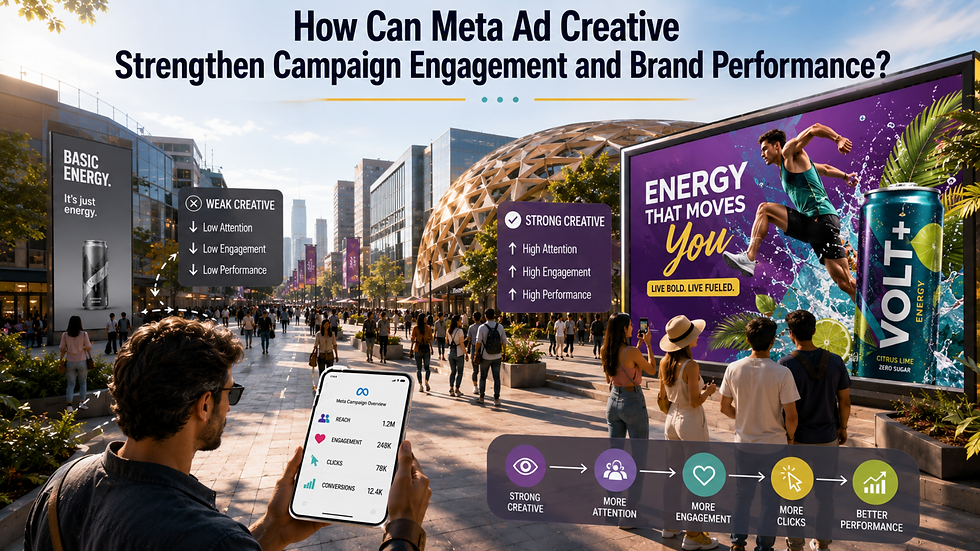
Why Is Creative Variety Important?
Audiences can become less responsive when they repeatedly encounter similar visuals and messages. Creative variety gives marketers more opportunities to understand which communication styles resonate with different segments.
For example, the same product might be promoted through:
A product demonstration
A customer problem-solution story
A benefit-focused visual
A lifestyle-oriented concept
A limited-time offer
Testing these approaches can reveal which creative direction deserves further investment.
How Can Marketers Improve Creative Testing?

Creative testing works best when the variables being compared are clearly defined.
Suppose a team wants to learn whether a problem-focused hook performs better than a benefit-focused hook. It can create two ads using similar visual structures while changing the opening message.
Relevant performance indicators may include:
Click-through rate
Conversion rate
Cost per acquisition
Engagement
Landing-page actions
Revenue
Return on advertising spend
The most important metric depends on the campaign objective. High engagement can be useful for awareness, but sales-focused campaigns require deeper conversion analysis.
How Does AI Assist With Campaign Optimization?
AI can help marketers identify patterns in large amounts of campaign data. It may highlight which audience groups are responding well, which creative formats are weakening, or where spending is becoming less efficient.
This can help teams decide when to:
Shift budget
Refresh creative
Adjust targeting
Test another format
Review an offer
Investigate a conversion problem
Human oversight remains important because automated systems can respond to short-term fluctuations or incomplete data.
What Makes Advertising Copy More Effective?
Strong copy should quickly communicate why the audience should care. A useful advertising message generally connects a customer need with a meaningful benefit.
A simple structure might be:
Problem → Benefit → Proof → Action
For example, instead of describing a product only through features, the advertisement can explain the customer problem, show how the product addresses it, provide credible supporting information, and finish with a clear next step.
Clarity is usually more useful than trying to fit every product detail into one advertisement.
How Can an AI Ad Generator Support Marketing Teams?
An AI Ad Generator can help marketers create starting points for headlines, descriptions, calls to action, and creative variations.
It may be especially useful when a campaign requires multiple versions for different audiences or platforms. However, generated copy still needs editing for accuracy, tone, originality, compliance, and brand consistency.
AI should support the creative workflow rather than become the final decision-maker.
How Should Brands Manage Their Budget?

Budget allocation should reflect campaign objectives, audience size, conversion economics, and actual performance.
A useful process is:
Start → Test → Measure → Optimize → Scale
Instead of immediately committing a large budget to one creative concept, marketers can begin with controlled testing and gradually increase investment in stronger-performing approaches.
This can reduce the risk of spending heavily on assumptions that have not yet been validated.
Why Is Measurement Essential?
Advertising performance cannot be evaluated reliably without consistent measurement. Marketers should connect campaign activity with meaningful business outcomes.
That means looking beyond vanity metrics and asking:
Are the right people responding?
Are clicks producing valuable visits?
Are leads becoming customers?
Is customer acquisition becoming more efficient?
Is revenue improving relative to spend?
When measurement is reliable, campaign optimization becomes more strategic.
How Can Human Review Improve AI-Assisted Advertising?
AI can generate content quickly, but people remain responsible for judging whether the content is appropriate.
Before publishing, teams should review:
Product accuracy
Claims
Pricing
Brand voice
Visual representation
Audience relevance
Platform requirements
Customer expectations
This is particularly important for advertisements that contain testimonials, statistics, financial claims, health information, or promotional promises.
What Should Businesses Expect From AI-Assisted Meta Advertising?
A strong Meta advertising program is not built around automation alone. It combines audience understanding, creative experimentation, reliable measurement, and continuous refinement.
AI can improve speed and scale, but the strongest results come from using it within a disciplined marketing framework. Businesses that treat every campaign as an opportunity to test, learn, and improve are better positioned to build sustainable social advertising performance.
You can also watch: AdsGPT: Day 1 on Autopilot
Summary
Effective Meta Ad requires more than creating attractive visuals. Brands need clear objectives, relevant audiences, compelling messaging, creative variation, disciplined testing, accurate measurement, and thoughtful optimization. AI can strengthen this process by accelerating creative production and helping marketers interpret performance patterns, while human judgment keeps the final strategy relevant and responsible.
Frequently Asked Questions
What is a Meta advertisement?
It is a paid promotional message delivered through Meta's advertising ecosystem, designed to reach selected audiences and support goals such as awareness, engagement, leads, or sales.
Can AI create social media advertisements?
Yes. AI tools can assist with ad copy, creative concepts, image ideas, video scripts, and variations, but human review remains important.
How many creatives should a campaign test?
There is no universal number. Marketers should test enough meaningfully different concepts to learn which approaches perform best without creating unnecessary complexity.
What should marketers measure?
Metrics should match the campaign objective, but common measures include click-through rate, conversions, acquisition cost, revenue, engagement, and return on advertising spend.
Can AI improve advertising results?
AI can support faster production, personalization, analysis, and optimization, but results still depend on targeting, creative quality, campaign structure, measurement, and market conditions.


Comments