How Can Meta Ad Creative Strengthen Campaign Engagement and Brand Performance?
- mosciskieleonore7
- 21 hours ago
- 5 min read
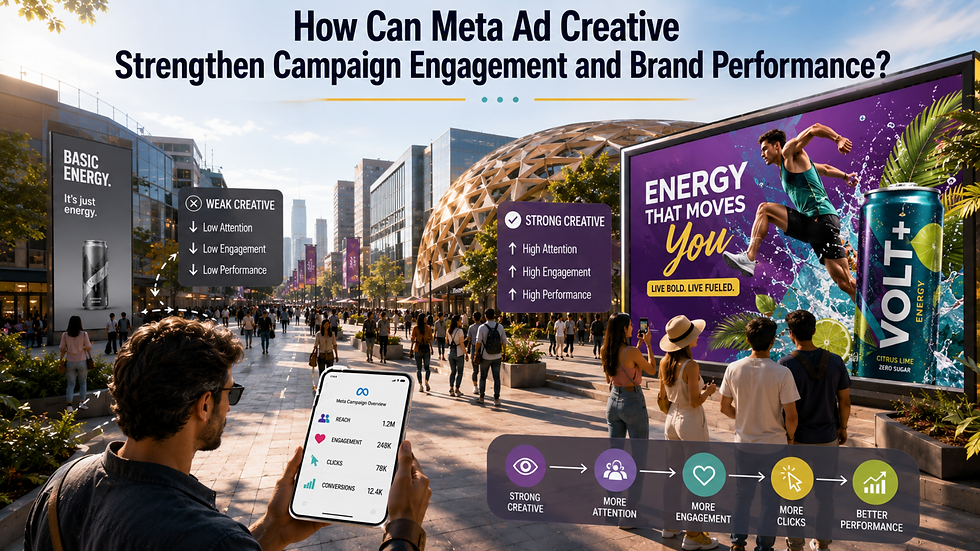
Are your social advertisements getting impressions but struggling to earn meaningful attention? Could a stronger combination of visuals, messaging, and format help your campaigns connect with the people most likely to respond? A strong advertisement plays an important role in shaping how audiences experience a brand on social platforms, from the first visual impression to the final call to action.
The basic answer is straightforward: effective ad creative should communicate a clear value, match the audience's expectations, fit the placement, and give people a reason to act. Strong creativity is not simply attractive. It must work with targeting, campaign objectives, and testing to support measurable business outcomes.
What Makes Social Ad Creative Effective?
Meta Ad Creative usually communicates its main idea within seconds. People should be able to understand what is being promoted, why it may matter to them, and what action they can take next.
Several elements influence that experience:
A clear visual hierarchy
A relevant customer benefit
Simple and readable copy
Strong product presentation
A recognizable brand identity
A direct call to action
The exact combination depends on the campaign. Awareness campaigns may prioritize memorable visuals, while conversion campaigns often need greater emphasis on product value and action.
How Should Marketers Match Creative to Campaign Objectives?
Creative should support the specific job the campaign is trying to accomplish.
Awareness Campaigns
These need strong brand recognition and memorable visual communication. A distinctive visual style can help audiences remember the company even when they are not ready to buy.
Consideration Campaigns
These can focus more heavily on benefits, demonstrations, comparisons, testimonials, or educational information.
Conversion Campaigns
These often require a clearer offer, stronger value proposition, product proof, and an obvious next step.
A creative strategy becomes more effective when marketers avoid using the same message structure for every stage of the customer journey.
How Can Marketers Build Better Visual Concepts?

Good visual development begins with the customer rather than the design software. Marketers should first identify what they want the viewer to notice, feel, understand, and do.
A useful creative brief can answer four questions:
Who is the audience?
What problem or desire matters to them?
What is the strongest product benefit?
What action should follow?
From there, teams can explore concepts that are visually and strategically connected to those answers.
This is where Ad Creative Testing becomes particularly valuable. Instead of debating whether one design is “better,” marketers can compare multiple concepts and determine which one produces stronger audience and business responses.
Why Does Creative Format Matter?
An advertisement designed for one placement may not perform equally well in another. A horizontal creative may work for a particular placement but lose visual impact when adapted to a vertical mobile environment.
Marketers should consider whether the concept works naturally as:
A static image
A carousel
A short video
A story
A product demonstration
A testimonial
The goal is not to create every format simply because it is available. The format should strengthen how the message is delivered.
How Does Creative Testing Improve Decision-Making?
Creative testing gives teams a way to replace assumptions with evidence. A controlled experiment can compare two or more versions while keeping important campaign variables consistent.
For example, a brand might test:
Version A: lifestyle image + emotional headline
Version B: product close-up + benefit-led headline
Depending on the campaign goal, marketers can evaluate click-through rate, engagement, conversion rate, cost per acquisition, or revenue.
Testing should be designed around a clear hypothesis. Changing the image, headline, audience, offer, placement, and landing page simultaneously makes it harder to understand what caused the result.
How Can AI Support Ad Creative Development?

AI can help marketing teams increase the number of creative directions they can explore. It can assist with headline generation, image concepts, short-form scripts, product-focused variations, and audience-specific messaging.
This can shorten the early ideation stage and make experimentation more accessible to smaller teams.
However, AI-generated concepts should still be reviewed for accuracy, originality, brand consistency, and audience relevance. Automation can increase production speed, but it cannot determine whether an idea is strategically appropriate without meaningful human input.
How Can Creative Design Ideas Make Campaigns More Distinctive?
Effective creative design ideas often come from changing the way a familiar message is presented rather than simply adding more visual elements.
For example, marketers could explore:
A product shown in an unexpected context
A customer problem represented visually
A strong comparison between before and after
Minimalist layouts with one dominant message
Motion-based storytelling for short video
Human-centered imagery instead of product-only visuals
Distinctive design does not require visual complexity. A simple concept can be highly memorable when the composition, message, and emotional direction are clear.
How Important Is Brand Consistency?
Consistency helps customers recognize an advertisement as part of a broader brand rather than an isolated piece of content.
That does not mean every creative should look identical. Instead, brands can maintain consistent foundations such as:
Typography
Logo treatment
Core colors
Photography style
Tone of voice
Visual personality
Within those boundaries, marketers can experiment with different layouts, hooks, formats, and storytelling approaches.
How Can Marketers Prevent Creative Fatigue?

Even strong advertisements can lose effectiveness when the same audience sees them too frequently. When engagement begins to weaken, marketers should investigate whether creative repetition is contributing to the decline.
Refreshing a campaign might involve:
New Hook → New Visual → New Message → New Format
A refresh is more useful when it introduces a meaningful creative difference rather than changing only a background color or minor wording.
What Should Marketers Measure?
Creative performance should be connected to the campaign objective. Instead of focusing on one headline metric, marketers should examine the relationship between attention and business results.
Useful questions include:
Did the creative earn attention?
Did viewers understand the offer?
Did engagement lead to qualified traffic?
Did clicks produce conversions?
Did the new version improve efficiency?
These answers help teams understand not just which advertisement won, but why it may have performed better.
How Can Businesses Improve Their Creative Workflow?
A practical workflow can make creative development more repeatable:
1. Define
Establish the audience, objective, message, and desired action.
2. Develop
Create several meaningful creative directions.
3. Review
Check accuracy, brand fit, clarity, and originality.
4. Test
Compare variations using appropriate performance metrics.
5. Learn
Identify patterns in audience response.
6. Refresh
Use those insights to develop the next generation of creative.
This creates a continuous learning cycle rather than treating each campaign as a one-time design exercise.
You can also watch: How to Create Winning Ad Hooks With AI
Summary
Meta Ad Creative can influence how effectively a social campaign captures attention, communicates value, and encourages action. Strong results come from combining relevant messaging, appropriate formats, thoughtful design, controlled testing, reliable measurement, and continuous creative improvement.
AI can accelerate idea development and variation, but marketers remain responsible for deciding what is useful, distinctive, accurate, and aligned with the brand.
FAQs
What is Meta ad creative?
It refers to the visual and messaging elements used in advertisements, including images, videos, headlines, descriptions, and calls to action.
Why should marketers test different ad creatives?
Testing helps determine which creative elements generate stronger audience engagement and business outcomes instead of relying only on subjective opinions.
Can AI create ad creative?
Yes. AI tools can assist with copy, visuals, scripts, and variations, but human review remains important before publication.
Should every campaign use multiple formats?
Not necessarily. Marketers should select formats that fit the audience, platform placement, and campaign objective.
How often should ad creative be refreshed?
There is no universal schedule. Creative should be reviewed regularly and refreshed when performance trends suggest the audience is becoming less responsive.


Comments