How Can Generative AI Transform the Way Businesses Create and Use Digital Content?
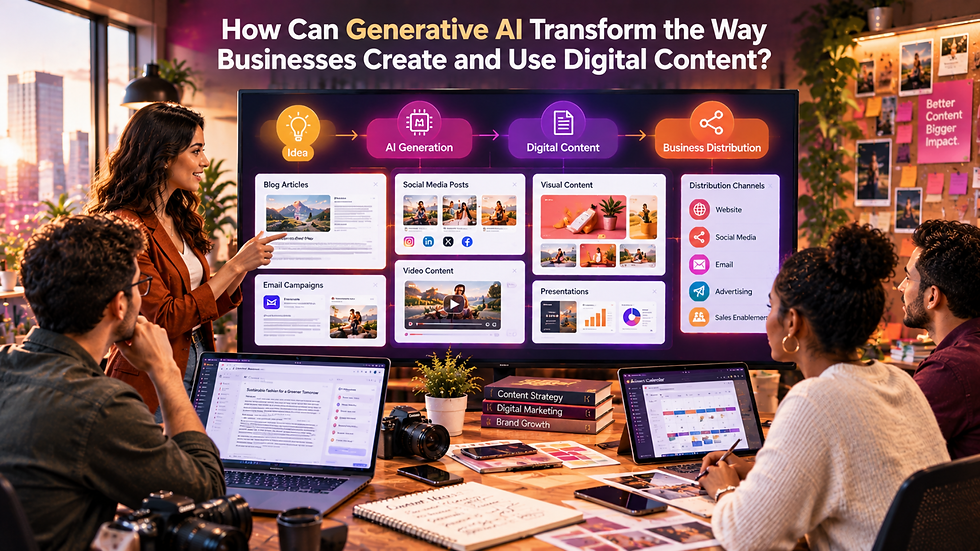
Could technology help businesses move from a simple idea to a polished piece of content in minutes? Generative AI is changing how organizations approach writing, design, research, brainstorming, and digital communication by assisting with tasks that once required significant manual effort.
The short answer is yes. Generative AI can produce new text, images, audio, video concepts, summaries, and other digital assets based on instructions provided by users. Its biggest advantage is not simply automation; it is the ability to accelerate creative workflows while giving teams more opportunities to experiment, personalize, and refine their work.
However, effective implementation requires more than generating content automatically. Human expertise, fact-checking, strategic direction, and editorial judgment remain essential.
What is generative AI and how does it work?
Generative AI refers to artificial intelligence systems designed to create new material based on patterns learned from large amounts of data.
Instead of simply retrieving an existing answer, these systems can generate an output based on a prompt or set of instructions.
Depending on the technology, businesses can use generative systems to develop:
Written articles and reports
Advertising concepts
Social media posts
Product descriptions
Images and design concepts
Video scripts
Presentation content
Summaries and outlines
Brainstorming ideas
Customer communication drafts
The quality of the result depends heavily on the quality of the instructions, available context, data, and human review.
What are the biggest advantages of generative AI?

The technology can influence several areas of business productivity.
Faster ideation
Creative teams can generate numerous concepts quickly, making it easier to explore different directions before committing resources to production.
Greater personalization
Businesses can adapt messaging for different audiences, channels, customer stages, or campaign objectives without manually creating every variation from scratch.
More efficient workflows
AI can assist with repetitive tasks such as summarization, rewriting, formatting, brainstorming, and content adaptation, allowing employees to focus on more strategic responsibilities.
Easier experimentation
Producing multiple concepts at a lower initial effort makes testing different messages, formats, and creative approaches more practical.
How can businesses use an AI content generator?
An AI content generator can be useful when teams need to overcome repetitive production tasks or develop multiple creative directions quickly.
For example, a marketing team launching a new product might use AI to brainstorm headlines, draft several promotional messages, create social post variations, and develop different audience-focused concepts.
A practical workflow could look like this:
Define the audience and business objective.
Provide relevant product or brand information.
Generate several initial concepts.
Select the strongest ideas.
Add expert knowledge and brand-specific details.
Fact-check the material.
Edit for tone, clarity, and originality.
Publish and monitor performance.
This approach keeps people involved throughout the process instead of treating AI output as automatically publishable.
How should organizations manage AI-generated output?

Speed should never come at the expense of accuracy or trust. Businesses need a review process that determines whether generated material meets their quality standards.
Important safeguards include:
Verify factual claims before publication.
Review statistics, names, dates, and technical information.
Protect confidential and sensitive business information.
Check whether the material reflects the organization's actual values.
Remove repetitive or generic language.
Review content for unintended bias or misleading statements.
Maintain clear human accountability.
This is particularly important when AI is used for industries where inaccurate information can have serious consequences.
How does generative technology affect marketing strategy?
Marketing teams can use AI to move from one-size-fits-all communication toward more adaptive campaigns.
Potential applications include:
Audience-specific messaging
Creative variation testing
Campaign brainstorming
Customer journey content
Product recommendations
Automated summaries
Email personalization
Advertising copy development
The strategic advantage comes from combining speed with insight. AI can help teams explore more possibilities, but marketers still need to decide which ideas are appropriate for their audience and brand.
How can AI support modern content creation?
As digital channels continue to expand, AI content creation can help organizations manage the growing demand for relevant material across websites, social platforms, email campaigns, video channels, and other communication formats.
Instead of viewing AI as a replacement for creative professionals, businesses can use it as a collaborative layer within existing workflows.
For example, a writer might use AI to develop an outline, a designer could explore visual concepts, and a marketing strategist could generate campaign variations. Each professional can then apply experience and judgment to improve the final result.
This collaborative model is especially useful for content repurposing. A detailed report could become a blog article, social media posts, an email newsletter, a video script, and a collection of frequently asked questions.
What are the limitations businesses should understand?

AI-generated material is not automatically accurate, original, or strategically appropriate.
Common challenges include:
Incorrect or outdated information
Generic writing patterns
Limited understanding of business context
Inconsistent brand voice
Potential intellectual-property concerns
Overdependence on automated recommendations
Reduced originality when teams use identical approaches
Businesses should therefore establish clear guidelines for when AI can be used, what information can be entered into systems, and how generated material must be reviewed.
What does the future of AI-assisted work look like?
The long-term opportunity is likely to involve collaboration rather than complete replacement. Employees who understand how to direct AI effectively can use it to accelerate research, explore ideas, automate repetitive processes, and create more variations.
The human role remains essential because people provide context, empathy, experience, strategic thinking, and accountability.
As organizations become more comfortable with the technology, successful adoption will depend less on simply having access to AI tools and more on knowing where AI adds value and where human expertise matters most.
You can also watch: AdsGPT Marketing Script Built to Scale
Summary
Generative AI can help businesses accelerate creative production, automate repetitive work, personalize communication, and experiment with new ideas. Its greatest value comes when organizations combine technological efficiency with human expertise, strong editorial standards, responsible data practices, and clear strategic goals.
FAQs
What is generative AI used for?
It can be used to create or assist with text, images, audio, video concepts, summaries, marketing materials, software-related outputs, and many other forms of digital work.
Can generative AI replace content creators?
It can automate portions of content production, but creators remain important for strategy, originality, expertise, storytelling, quality control, and brand direction.
Is AI-generated content always accurate?
No. AI systems can produce incorrect or misleading information, so important claims should always be reviewed and verified by humans.
How can businesses use AI responsibly?
Organizations should establish usage guidelines, protect confidential information, verify outputs, maintain human oversight, and ensure AI-assisted work meets their quality and ethical standards.
What is the main benefit of using AI for content?
The primary benefit is efficiency. AI can help teams move faster from ideas to workable drafts and variations, allowing professionals to spend more time on strategy, creativity, and refinement.


Comments