How Can an AI Ad Generator Simplify Modern Campaign Creation?

How quickly can a business turn an advertising idea into a campaign-ready asset? For many marketing teams, traditional advertising production involves research, copywriting, design, revisions, resizing, approvals, and platform-specific adaptations. Artificial intelligence can streamline several of these steps, helping teams move from an initial concept to multiple advertising variations much faster.
An AI advertising platform is an AI-powered tool that helps marketers create advertising copy, visuals, concepts, calls to action, headlines, and campaign variations based on information such as a product, target audience, campaign objective, and brand style. Its primary value is not simply automation, it is the ability to expand creative experimentation while reducing repetitive production work.
For businesses managing multiple campaigns, AI can make the creative process more flexible, scalable, and responsive to changing audience behavior.
What can an AI advertising tool actually create?
Modern AI Ad Generator can support different parts of the creative process. Depending on the technology being used, marketers may generate or refine:
Advertising headlines
Product descriptions
Promotional copy
Social media advertisements
Display ad variations
Calls to action
Image concepts
Short-form video ideas
Audience-specific messaging
Campaign creative variations
Rather than treating each output as a finished advertisement, marketers can use these assets as starting points. Human professionals can then refine the language, visuals, positioning, and overall message.
This creates an efficient partnership between automation and creative judgment.
How does AI accelerate the advertising workflow?

A conventional campaign may require several people to work sequentially. AI can help compress parts of that process by producing initial options quickly.
A practical workflow might look like this:
Campaign Goal → Audience Research → Creative Concepts → AI-Assisted Production → Human Review → Testing → Optimization
For example, a company launching a new fitness product could provide information about its product benefits, ideal customer, brand personality, and promotional offer. The system could then suggest different advertising messages aimed at beginners, experienced athletes, or customers interested in convenience.
The marketing team can compare these options and select the ideas that best match the campaign strategy.
How can an AI content generator improve creative productivity?
An AI content generator can be particularly useful when marketing teams need large volumes of variations. Creating ten different headlines manually may take considerable time, especially when each version needs a different emotional angle or audience focus.
AI-assisted generation can provide initial alternatives based on specific instructions. A marketer might request professional, conversational, urgent, educational, or benefit-focused versions of the same message.
This can help teams:
Explore more creative directions.
Reduce repetitive writing tasks.
Adapt messaging for different channels.
Produce campaign variations more efficiently.
Spend more time on strategic decisions.
However, generated content still requires careful editing. Businesses should check facts, product claims, tone, grammar, brand terminology, and audience suitability before publication.
Can AI improve advertising personalization?
Consumers encounter advertisements across many platforms, and generic messaging may not always capture their attention. AI can help marketers develop creative variations based on audience characteristics and campaign objectives.
For example, the same product could be promoted differently to:
New customers discovering the brand
Returning website visitors
Existing customers
Price-conscious shoppers
Customers interested in premium features
The underlying product remains the same, but the message can emphasize different benefits.
AI can also help adapt creative assets to different placements. A campaign might require a short social caption, a compact display headline, a longer promotional message, and a mobile-friendly call to action. Automation makes producing these variations more manageable.
How can marketers use AI for creative testing?
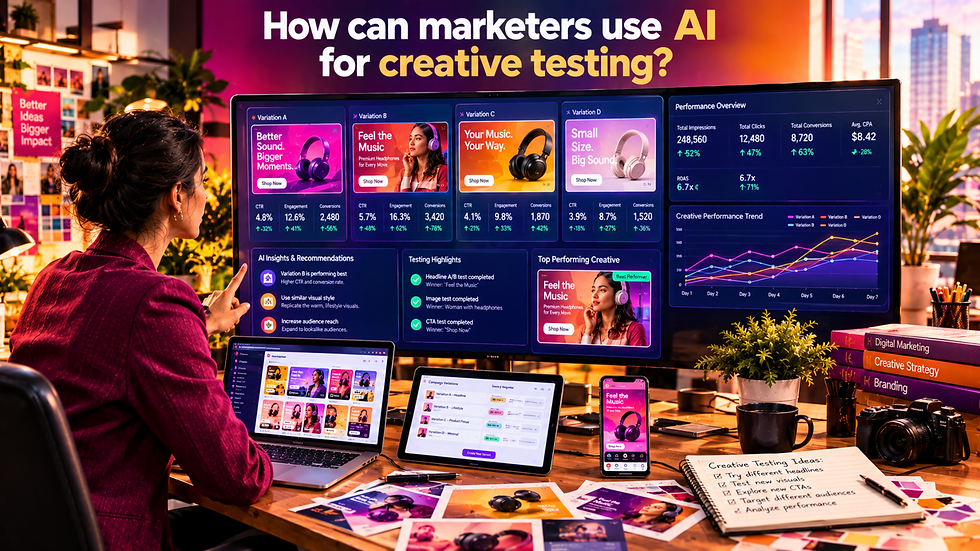
Advertising performance often depends on details that are difficult to predict before launch. A headline that appears compelling internally may perform poorly with the actual audience, while a simple visual or message may generate stronger engagement.
This makes testing essential.
Marketers can experiment with combinations of:
Headlines
Images
Video openings
Calls to action
Offers
Product benefits
Messaging styles
Audience segments
Useful metrics may include click-through rate, conversion rate, engagement, cost per acquisition, return on advertising spend, and video completion rate. These measurements should be evaluated together because strong clicks do not necessarily translate into valuable conversions.
What role does human creativity still play?
Display ad generator can produce numerous possibilities, but quantity does not automatically equal quality. Advertising still depends on understanding people, culture, emotion, brand positioning, and context.
Human marketers remain essential for deciding:
What the brand should stand for
Which audience problem deserves attention
Which creative concept feels distinctive
Whether a message is credible
How an advertisement should make people feel
Whether generated material fits the brand identity
AI is most useful when it supports these decisions rather than replacing them.
What should businesses consider before adopting AI advertising tools?

Organizations should establish clear guidelines before integrating AI into their creative workflow.
Brand consistency
Create clear rules for tone, visual identity, terminology, messaging, and approved claims.
Accuracy
Review AI-generated information carefully, particularly when advertisements contain statistics, product specifications, health-related claims, or pricing information.
Originality
Avoid publishing generic outputs without refinement. Strong advertising should have a recognizable point of view.
Privacy and security
Businesses should understand what information is entered into an AI platform and how that information is handled.
Platform compliance
Advertising content should meet the requirements of the platforms where it will be published.
How can businesses build a practical AI advertising workflow?
A strong implementation does not require organizations to automate everything immediately. Businesses can begin with repetitive creative tasks and gradually expand their use of AI.
A practical approach is:
Identify time-consuming creative tasks.
Define brand and campaign guidelines.
Use AI to generate initial concepts.
Have marketers review and refine the output.
Test multiple creative variations.
Analyze campaign performance.
Use the findings to improve future campaigns.
This approach allows companies to gain efficiency while retaining strategic and creative control.
You can also watch: How to Produce High-Converting Video Ads Without a Film Crew
Summary
AI Ad Generator is becoming a valuable part of modern advertising because it can accelerate content production, expand creative experimentation, support personalization, and simplify campaign adaptation. The strongest results come when AI-generated ideas are combined with human strategy, editing, brand knowledge, and performance analysis.
Rather than replacing creative teams, AI can reduce repetitive work and give marketers more opportunities to experiment. Used responsibly, it can turn advertising production into a faster and more adaptable process.
FAQs
What is an AI Ad Generator?
It is an artificial intelligence-powered tool that helps create advertising concepts, copy, visuals, headlines, calls to action, and campaign variations.
Can AI generate complete advertisements?
Some platforms can produce multiple components of an advertisement, while others can create complete creative assets. Human review is still important before publication.
Is AI-generated advertising suitable for small businesses?
Yes. Small businesses can use AI to create initial campaign ideas and variations without requiring extensive creative resources.
Can AI improve advertising performance?
It can support experimentation, personalization, and optimization, but results also depend on targeting, offers, landing pages, audience demand, and overall campaign strategy.
Should marketers publish AI-generated ads without editing?
No. Reviewing AI output helps identify factual errors, inappropriate claims, inconsistent branding, and generic messaging before an advertisement reaches customers.


Comments