How Can AI Ads Help Businesses Create Smarter and More Effective Campaigns?
- mosciskieleonore7
- 3 days ago
- 5 min read

What makes an advertisement effective in a crowded digital environment—better targeting, stronger creative, faster production, or a message that feels relevant to the right customer? AI-powered advertising are changing how businesses approach these challenges by using artificial intelligence to support creative development, audience analysis, personalization, testing, and campaign optimization.
In simple terms, AI can help marketers create advertising concepts faster, adapt messages for different audiences, analyze campaign signals, and identify opportunities for improvement. The technology does not guarantee stronger results on its own, but it can give marketing teams more ways to experiment, learn, and optimize.
What Are AI-Powered Advertisements?
AI ads refers to the use of artificial intelligence across different stages of the advertising process. Depending on the platform, AI may assist with audience segmentation, creative generation, copywriting, image creation, video production, bidding, recommendations, and performance analysis.
Instead of building one advertisement and waiting for results, marketers can develop a broader set of creative options and evaluate how different approaches perform.
Common AI-assisted advertising activities include:
Generating headline and copy variations
Creating visual concepts
Adapting advertisements for different placements
Personalizing messages for audience segments
Predicting potential campaign outcomes
Identifying underperforming creative
Automating repetitive production tasks
How Can AI Improve Advertising Efficiency?
One major advantage of AI is its ability to process repetitive tasks quickly. Advertising teams often need numerous headlines, descriptions, image sizes, video versions, and calls to action for a single campaign.
Manual production can slow down experimentation. AI can generate initial versions that marketers can review, edit, and improve.
Which Advertising Tasks Can AI Support?

AI is particularly useful when the work involves repeatable structures or multiple variations.
For example, a business launching a new product might need:
Awareness advertisements for new audiences.
Benefit-focused ads for interested prospects.
Promotional ads for high-intent shoppers.
Retargeting messages for previous visitors.
AI can help produce the foundations for these variations, allowing marketers to spend more time on strategy and quality control.
Can AI Improve Visual Ad Creation?
Advertising increasingly depends on strong visual communication. Marketers may need banners, social graphics, product images, display assets, and multiple creative dimensions.
An AI banner maker can help teams generate preliminary banner concepts, experiment with layouts, and adapt creative ideas for different placements. Human designers can then refine typography, imagery, hierarchy, branding, and accessibility.
The goal is not simply to generate more graphics. Effective visual advertising still needs a clear focal point, readable messaging, accurate product representation, and a strong connection to the campaign objective.
How Can AI Help Personalize Advertising?
Different customers can respond to different benefits. A first-time buyer may want an explanation of what a product does, while an existing customer may be more interested in an upgrade or complementary product.
AI can help marketers adapt advertising based on:
Customer interests
Buying stage
Previous interactions
Demographic or behavioral segments
Product preferences
Campaign objectives
This can make advertisements more relevant without requiring completely separate campaigns for every customer group.
How Does AI Support Creative Testing?
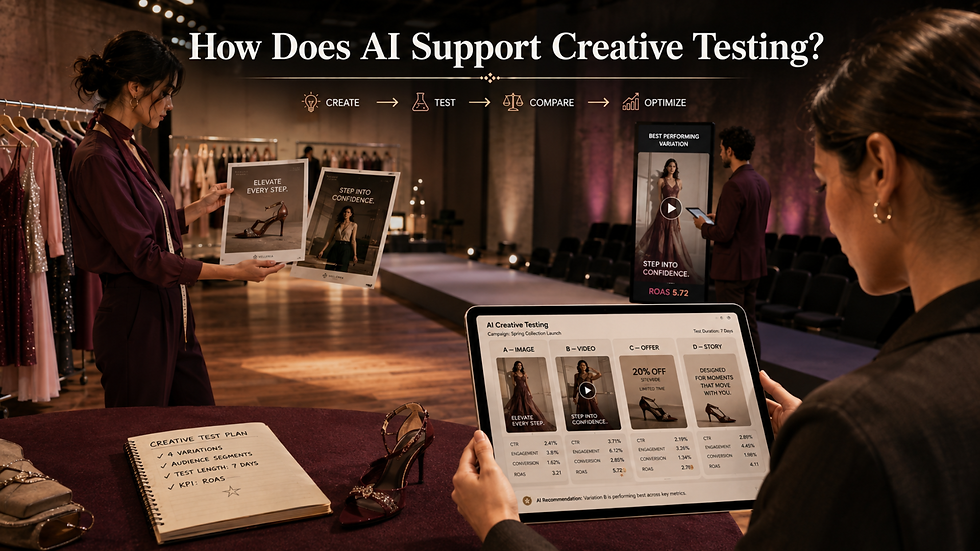
Creative testing allows marketers to compare different messages and visual approaches instead of relying on assumptions.
A structured test might compare:
Benefit-led versus emotion-led headlines
Product imagery versus lifestyle imagery
Short versus detailed copy
Educational versus promotional messaging
Different calls to action
AI can help create these variations and analyze patterns across performance data.
Marketers should still define what success means before running a test. Depending on the campaign, useful measures may include click-through rate, conversions, cost per acquisition, revenue, or return on advertising spend.
How Can AI Help With Campaign Optimization?
After advertisements are published, AI can help identify patterns that may be difficult to spot manually across large datasets.
For example, a system might highlight a particular audience segment with stronger conversion behavior or identify a creative that is generating engagement but failing to produce purchases.
This broader perspective can help marketers make more informed decisions about:
Budget allocation
Audience targeting
Creative rotation
Campaign timing
Placement selection
Landing-page alignment
However, automated recommendations should be reviewed carefully. A short-term spike in performance does not always indicate a sustainable trend.
What Is an AI Maker in Advertising?
An AI maker can refer broadly to a tool that uses artificial intelligence to help users create digital assets such as advertisements, images, videos, copy, or campaign concepts.
These tools are becoming useful because modern advertising requires content for many channels simultaneously. A marketer may need a social post, display asset, short-form video, product description, and landing-page message based on one campaign idea.
AI can help transform the central idea into multiple formats, reducing repetitive work and making cross-channel adaptation easier.
The quality of the final result still depends on the information supplied, the creative direction, and the review process.
What Role Does Human Creativity Play?
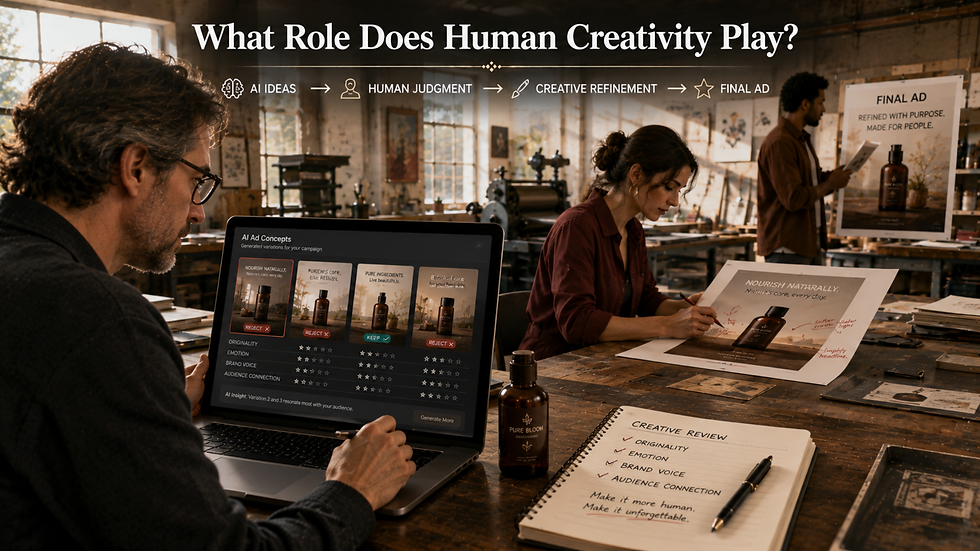
Automation works best when it supports human judgment rather than replacing it.
Marketers understand the emotional, cultural, and commercial context behind a campaign. They can recognize whether a message feels authentic, whether a claim is appropriate, and whether a creative concept actually fits the brand.
Before publication, teams should review:
Product information
Promotional claims
Brand voice
Visual accuracy
Audience relevance
Legal or platform requirements
Calls to action
Customer expectations
Human review is especially important when advertisements involve pricing, financial claims, health-related information, or customer testimonials.
What Are the Risks of AI Advertising?
AI can introduce challenges as well as efficiencies. Generated content may be repetitive, inaccurate, overly generic, or poorly aligned with a company's positioning.
There can also be concerns involving privacy, intellectual property, synthetic media, data quality, and excessive reliance on automation.
A responsible workflow should therefore be:
Research → Brief → Generate → Review → Test → Measure → Refine
This approach keeps AI useful while maintaining accountability.
How Can Businesses Use AI Ads Strategically?
ai ads are most valuable when they become part of a disciplined marketing process rather than a shortcut around strategy.
Businesses should start with a clear objective, provide accurate information, generate meaningful creative variations, and test those variations against measurable goals. Campaign data can then guide future decisions.
The real advantage is not simply faster advertising production. It is the ability to explore more possibilities, learn from campaign performance, and continuously improve how a brand communicates with customers.
You can also watch: How to Automate Your Ad Workflow with AdsGPT
Summary
AI ads can help businesses streamline advertising production, personalize messages, create visual assets, test creative directions, and analyze performance. Its effectiveness depends on accurate data, thoughtful strategy, strong creative direction, and human oversight.
FAQs
What are AI-powered ads?
They are advertisements created or optimized with artificial intelligence across areas such as copywriting, design, targeting, personalization, and campaign analysis.
Can AI create complete advertisements?
Many AI tools can assist with multiple stages of ad production, but human review is still important for accuracy, brand consistency, and strategic quality.
Can AI improve advertising performance?
It can support better experimentation and optimization, but results depend on factors such as the audience, offer, creative quality, measurement, and market conditions.
Is AI useful for small businesses?
Yes. It can help smaller teams produce creative variations and marketing assets more efficiently without requiring a large production workflow.
Should marketers rely entirely on AI recommendations?
No. AI recommendations should be evaluated against business objectives, reliable performance data, brand guidelines, and human judgment.


Comments