How Can AI Ads Help Brands Create Smarter and More Effective Campaigns?

What if brands could turn one campaign idea into multiple creative concepts, audience variations, and advertising formats in a fraction of the usual time? AI-powered advertising are helping marketers do exactly that by combining automation, audience insights, creative generation, and performance analysis. The biggest advantage is not simply producing advertisements faster; it is creating a more responsive advertising workflow where teams can test ideas, understand results, and continuously improve campaigns.
What Are AI-Powered Advertisements?
AI ads use artificial intelligence to support different stages of campaign development, from research and creative production to audience targeting and optimization.
Instead of relying entirely on manual processes, marketers can use AI to:
Generate initial advertising concepts
Create different headlines and calls to action
Adapt messaging for audience segments
Analyze campaign performance
Identify promising creative variations
Automate repetitive advertising tasks
Predict which combinations may perform better
This allows marketing teams to spend less time on repetitive production and more time on strategy, positioning, storytelling, and customer understanding.
How Can AI Make Campaign Creation Faster?
Traditional advertising often requires several separate stages involving copywriters, designers, editors, analysts, and campaign managers. AI can connect many of these activities into a faster workflow.
A marketer might begin with a product brief and develop several assets through an assisted process:
Campaign Brief → Audience Research → Creative Ideas → Copy → Visual Concepts → Variations → Testing → Optimization
This does not mean every stage should be completely automated. Human review remains important for brand voice, accuracy, emotional relevance, legal requirements, and creative quality.
The real benefit is speed with control. Teams can explore more possibilities without increasing production effort at the same rate.
Can AI Improve Advertising Personalization?

One advertisement rarely appeals equally to every potential customer. Different audiences may respond to different benefits, language, imagery, offers, or calls to action.
AI can help marketers identify these differences and create more relevant variations. For example, a travel company might emphasize affordability for price-conscious customers, convenience for busy professionals, and premium experiences for luxury travelers.
Effective personalization can involve:
Customer interests
Previous interactions
Purchase behavior
Content engagement
Demographic patterns
Product preferences
Campaign history
However, personalization should remain useful rather than intrusive. Marketers need responsible data practices and clear boundaries around how customer information is collected and used.
How Does an AI Commercial Generator Support Creative Teams?
An AI commercial generator can help marketers explore commercial concepts before investing heavily in traditional production. Depending on the platform, it may assist with scripts, storyboards, scenes, visual concepts, voiceovers, or variations of an existing advertising idea.
For example, a brand launching a new fitness product could develop several commercial directions:
A motivational lifestyle story
A product demonstration
A customer-problem-and-solution concept
A short social-first commercial
A product-focused visual advertisement
Creative teams can then compare these directions and select the concept that best matches the campaign objective.
This approach can make experimentation easier while allowing human creatives to remain responsible for the final narrative and brand identity.
Why Is Creative Testing Essential for AI Advertising?
One of the strongest applications of artificial intelligence in advertising is the ability to support experimentation.
Rather than assuming one headline, image, or video will perform best, marketers can develop several variations and compare their results.
Useful testing variables include:
Headlines
Images
Video openings
Calls to action
Offers
Product positioning
Landing-page messages
Audience segments
Performance should be evaluated against the campaign objective. A creative with a high click-through rate is not automatically successful if those clicks fail to generate meaningful conversions.
Testing therefore works best when marketers connect creative performance with business outcomes.
How Can AI Help Marketers Understand Campaign Results?
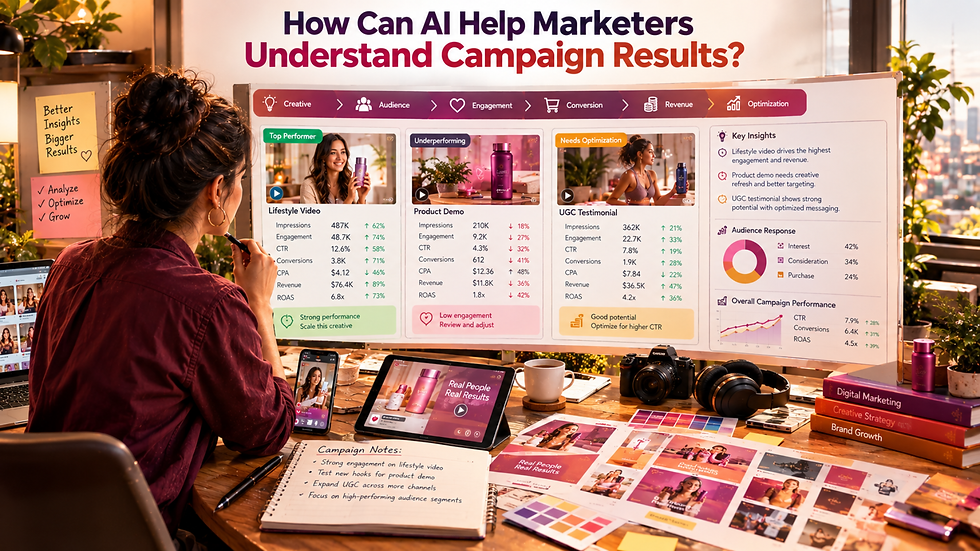
Modern campaigns generate large amounts of performance information. Reviewing every signal manually can become difficult, particularly when campaigns run across multiple channels and contain many creative variations.
AI can help identify patterns in metrics such as impressions, engagement, clicks, conversions, cost per acquisition, revenue, and return on advertising spend.
For example, an AI-assisted analysis might reveal that:
One video opening produces stronger engagement.
A particular audience responds better to product demonstrations.
A specific message generates more conversions.
Certain creatives experience declining performance after repeated exposure.
A campaign segment is consuming budget without producing sufficient results.
These insights can help marketers decide what to scale, revise, pause, or test next.
How Can an AI Post Generator Extend Campaign Content?
An AI post generator can help transform a central advertising message into supporting social content. Instead of creating every social post from scratch, marketers can develop variations around product launches, educational messages, customer benefits, promotions, testimonials, and campaign announcements.
For example, one product campaign could inspire:
Short promotional posts
Educational captions
Customer-focused stories
Product tips
Engagement questions
Promotional reminders
Social video concepts
The important distinction is that automation should support the campaign rather than make every piece of content sound identical. Human editing can preserve personality, context, originality, and brand consistency.
What Challenges Should Businesses Consider?

AI-powered advertising can improve efficiency, but it also introduces important considerations.
Businesses should pay attention to:
Accuracy: Generated claims should be reviewed before publication.
Originality: Automated outputs should not become repetitive or generic.
Brand consistency: Every variation should follow established brand guidelines.
Privacy: Customer information must be handled responsibly.
Human oversight: Important advertising decisions should not rely blindly on automated recommendations.
Measurement: AI-generated content should still be judged by meaningful business outcomes.
The goal is not to replace creative judgment. It is to give marketing teams better tools for exploring, producing, testing, and improving ideas.
How Should Brands Build an Effective AI Advertising Workflow?
A practical approach begins with the campaign objective rather than the technology.
A strong workflow can follow these steps:
1. Define the goal: Establish whether the campaign is focused on awareness, engagement, leads, sales, or retention.
2. Understand the audience: Identify customer needs, motivations, objections, and behaviors.
3. Generate creative directions: Use AI to explore multiple concepts rather than settling on the first idea.
4. Review and refine: Apply human judgment to messaging, visuals, accuracy, and brand fit.
5. Test variations: Compare different creative approaches against clearly defined metrics.
6. Analyze performance: Identify patterns that reveal what is working and what needs improvement.
7. Optimize continuously: Shift attention toward stronger creative, audiences, and messages while removing weak performers.
This process makes AI part of a disciplined marketing system rather than treating it as a shortcut.
To know more click on: Create Stunning Ads in Seconds with AdsGPT | Generative AI for Ads
Summary
AI ads can help brands accelerate creative production, personalize campaigns, explore more ideas, and analyze performance at scale. Its greatest value comes from combining machine-assisted efficiency with human strategy, creativity, judgment, and responsible decision-making. Brands that treat AI as a collaborative marketing tool can build faster experimentation cycles while keeping campaigns relevant and authentic.
FAQs
Are AI-powered advertisements effective?
They can be effective when AI is used alongside strong strategy, relevant audience targeting, high-quality creative, meaningful testing, and human oversight.
Can AI create complete advertising campaigns?
AI tools can assist with many campaign components, including ideas, copy, visuals, videos, variations, and analysis. Human review is still valuable for strategic and quality decisions.
Does AI replace advertising professionals?
AI can automate repetitive tasks, but creative strategy, brand positioning, storytelling, ethical judgment, and customer understanding still require human expertise.
What should marketers measure?
Metrics should match the campaign objective and may include engagement, CTR, conversions, CPA, revenue, retention, and return on advertising spend.
What is the best way to use AI in advertising?
Start with a clear business objective, use AI to expand creative and analytical capabilities, test multiple approaches, and continuously combine performance data with human judgment.


Comments