AI Ad Copy Generators: Can AI Transform The Way Businesses Write Ads?
- mosciskieleonore7
- 2 days ago
- 5 min read

Can businesses really create better advertising copy with artificial intelligence? How can marketers produce persuasive headlines, engaging descriptions, and strong calls to action without spending hours writing and rewriting the same ideas? AI is changing the way businesses approach advertising by making copy development faster, more scalable, and easier to test.
AI Ad Copy Generators: Can AI Transform the Way Businesses Write Ads? The short answer is yes, but AI works best as a marketing assistant rather than a complete replacement for human creativity. These tools can generate multiple advertising concepts from information such as a product description, target audience, campaign objective, brand tone, and desired outcome. Marketers can then refine the results and use performance data to determine which messages work best.
What Are AI Ad Copy Generators?
AI Ad Copy Generators are software solutions that use artificial intelligence and language-generation technology to create advertising copy. They can transform basic campaign information into headlines, descriptions, promotional messages, calls to action, and other forms of marketing content.
Businesses can use AI-generated copy across various channels, including search advertising, social media, digital display campaigns, email marketing, and promotional content. Instead of creating every variation manually, marketers can use AI to develop several starting points and then customize them according to their campaign requirements.
How Does AI Create Advertising Copy?

How does AI know what type of message might appeal to a particular audience? The process begins with the information supplied by the marketer. This can include the product or service being promoted, target audience, key benefits, campaign objective, preferred tone, keywords, and advertising platform.
The system analyzes these details and generates copy based on the requested requirements. For example, a business promoting project management software might request advertising copy focused on productivity, collaboration, time savings, or workflow efficiency.
The AI can create different versions around these themes, allowing marketers to compare messaging approaches instead of relying on a single advertisement.
Why Are Businesses Turning to AI for Ad Copy?

Traditional advertising copywriting can become time-consuming when campaigns require numerous variations. AI Ad Copy Generators help marketers streamline this process by quickly creating different headlines, descriptions, calls to action, and customized messages for specific audiences and advertising platforms. This allows businesses to explore more creative options, reduce repetitive writing, and focus more on campaign strategy and performance optimization.
Faster Content Production
AI can generate several copy concepts within seconds. This allows marketers to move quickly from brainstorming to editing and testing. The time saved can be redirected toward campaign planning, audience research, and optimization.
More Creative Ideas
Sometimes the biggest challenge is not writing the advertisement but finding a fresh angle. AI can suggest alternative ways to present a product's benefits, helping marketers explore messaging ideas they may not have considered initially.
Easier A/B Testing
Advertising performance often improves through experimentation. AI can create multiple headlines, descriptions, benefits, and calls to action that marketers can test against one another. This creates more opportunities to identify effective messaging.
Personalized Messaging
Different customers have different needs. AI can help create variations that emphasize specific benefits for different audience segments. A price-conscious audience, for example, may respond differently from an audience primarily interested in convenience or premium quality.
What Makes AI-Generated Ad Copy Effective?
Simply generating large amounts of text does not guarantee successful advertising. Effective copy needs to communicate a clear value proposition and connect with the audience's needs.
A strong advertisement typically begins with an attention-grabbing headline. It should then explain a relevant benefit in concise language and provide enough information to encourage further interest. A clear call to action should tell the audience what to do next.
The language should also be specific rather than generic. Instead of saying a product is "the best solution," effective copy can explain exactly how it solves a customer problem or improves an existing process.
Brand voice is another important consideration. A professional financial company may require a different tone from a lifestyle brand or entertainment business. AI-generated copy should therefore be edited to ensure that it sounds authentic to the organization.
What Are the Limitations of AI Ad Copy?
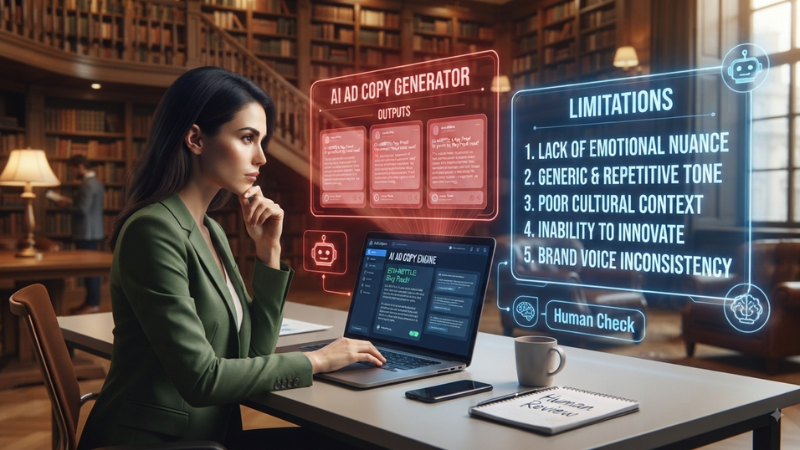
AI can accelerate content creation, but it is not perfect. Generated copy may sometimes sound repetitive, make unsupported claims, misunderstand context, or produce wording that does not accurately represent a product.
Human oversight is therefore essential. Marketers should verify factual information, review claims, check grammar, remove unnecessary wording, and ensure that the content follows advertising policies.
AI also lacks the complete strategic understanding that experienced marketers develop through customer research and campaign experience. It can generate language, but humans must determine whether the underlying message is actually relevant to the audience.
How Can Businesses Use AI More Effectively?
Businesses can get better results by treating AI as part of a structured creative workflow. First, provide detailed information about the product, audience, offer, and campaign objective. More useful input generally gives the system better context for generating relevant ideas.
Next, create and test several AI ads ROAS variations rather than relying on a single advertisement. Different versions can explore alternative benefits, messaging styles, emotional triggers, visuals, and calls to action, helping marketers identify which AI-powered ad variations generate stronger returns and improve overall advertising efficiency.
After reviewing the generated copy, marketers should select the strongest concepts and adapt them to the brand. Finally, campaign performance should be measured to determine which messages generate meaningful results.
Can AI Improve Advertising Performance?
AI does not automatically make an advertisement successful. Campaign performance depends on several factors, including audience targeting, offer quality, creative design, landing-page experience, competition, budget, and optimization.
However, AI can make the creative testing process more efficient. Marketers can produce more variations, test different messaging approaches, and use performance data to identify which concepts deserve further investment.
Metrics such as click-through rate, conversion rate, cost per acquisition, engagement rate, and return on ad spend can help determine whether a particular advertising message is delivering results.
You can also watch: Manage All Your Meta Ads in One Dashboard
Summary
Product video ads can transform the advertising workflow by making product promotion more engaging, visually appealing, and easier to adapt for different audiences and platforms. They can help businesses showcase product features, demonstrate benefits, build audience interest, and create multiple video variations for testing. However, the strongest results come from combining compelling visuals with clear messaging, creative storytelling, audience understanding, and continuous performance analysis.
AI should not replace the marketer's role. Instead, it can remove repetitive writing tasks and provide more opportunities to experiment with messages that connect with potential customers.
Frequently Asked Questions
Can AI write advertising copy?
Yes. AI can generate headlines, descriptions, promotional messages, and calls to action based on campaign information supplied by the marketer.
Is AI-generated ad copy effective?
It can be effective when the input is specific and the generated content is carefully reviewed, customized, and tested against real campaign performance.
Can AI create multiple versions of an advertisement?
Yes. AI can quickly generate different variations based on alternative benefits, tones, headlines, calls to action, and audience segments.
Should marketers publish AI-generated copy without editing?
No. Human review is important for accuracy, brand voice, factual claims, clarity, and advertising-policy compliance.
Will AI replace advertising copywriters?
AI can automate repetitive writing tasks, but human professionals remain valuable for creative strategy, positioning, audience research, brand development, and final decision-making.


Comments